

Cat-Kashi - Cat Litter Deodoriser & Extender
Cat-Kashi - Cat Litter Deodoriser & Extender
Couldn't load pickup availability


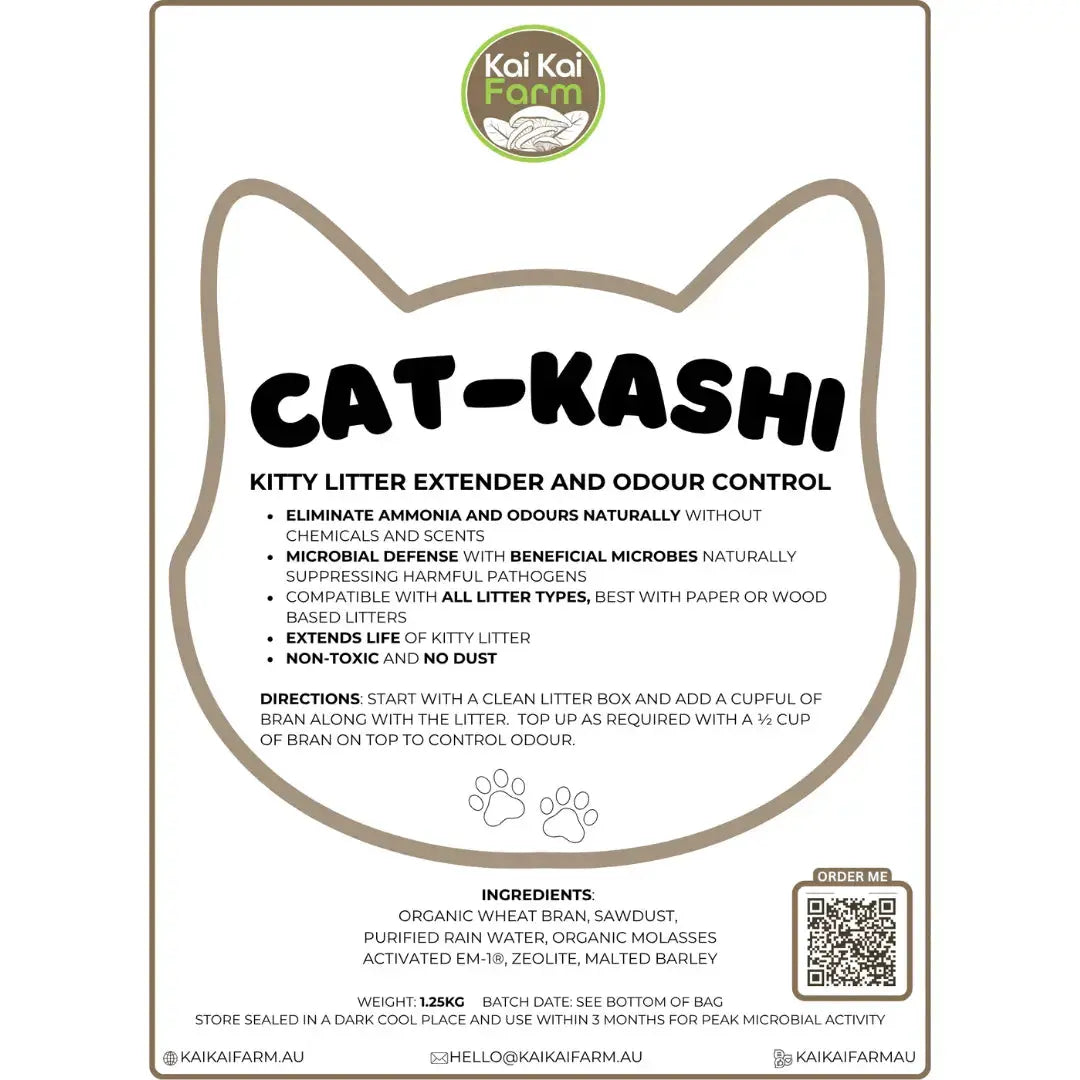
You shouldn't be able to smell the litter box from the hallway.
Cat-Kashi is an Australian-made litter deodoriser and extender that stops ammonia where it starts, instead of hiding it under perfume. Volcanic zeolite traps ammonia gas at the molecular level; live EM-1® cultures crowd out the bacteria producing it. The result is a tray that stays genuinely fresh for roughly twice as long between full changes — with no fragrance, no dust and nothing your cat wouldn't happily walk on. Made in small batches on our family farm at Tamborine Mountain.
Cat-Kashi is for you if…
- ✅ The ammonia hits you when you open the laundry or bathroom door
- ✅ You live in an apartment, townhouse or anywhere the tray is close to living space
- ✅ You're tired of buying litter every fortnight
- ✅ Your cat has asthma, sensitive paws or reacts to scented products
- ✅ You have two or more cats sharing a tray
- ✅ You'd rather not put synthetic fragrance in the room your cat sleeps in
Cat-Kashi is not…
- 🚫 A replacement for kitty litter — it's an additive that goes on top
- 🚫 A scented cover-up that masks smells with perfume
- 🚫 Dusty, clay-based or clumping
- 🚫 Going to scoop the tray for you… sorry
✓ Safe if ingested by cats, dogs and humans. Every ingredient is food-grade or mineral. No chemicals, no synthetic fragrance, no additives.
What's inside — and why it matters
Organic zeolite
A volcanic mineral with a honeycomb molecular structure that physically captures ammonia gas before it reaches the air. Unlike baking soda, which mostly absorbs moisture, zeolite targets the ammonia ion specifically — the compound behind that sharp, eye-watering smell. It's the same mineral used in drinking water filtration.
Activated EM-1® + organic wheat bran
Wheat bran inoculated with Dr Higa's original EM-1 consortium — lactic acid bacteria, yeasts and phototrophic bacteria. These beneficial microbes outcompete the odour-causing bacteria in the tray, fermenting waste compounds into neutral by-products rather than letting them rot.
Kiln-dried pine sawdust
Our pine is kiln-dried, which drives off the volatile aromatic phenols found in raw or green pine — the same process used for pine pellet litters sold for cats. What's left is a breathable, mildly antimicrobial carrier with an earthy texture cats instinctively accept, and exceptional compatibility with pine pellet and wood-based litters.
Malted barley + organic molasses
Malted barley carries natural enzymes that speed the breakdown of organic waste compounds. Molasses is the carbon source that keeps the EM cultures alive and multiplying from the moment Cat-Kashi meets moisture in the tray.
What you'll notice
- Ammonia knocked down within hours of the first application — usually the same day
- Litter staying usable roughly twice as long between full changes
- No perfume, no chemical top-note — the room just smells like nothing
- No dust cloud when you pour or scoop
- Your cat using the tray normally, without the rejection you get from scented additives
- Fewer litter bags in the bin, and a noticeably smaller litter bill
Why zeolite is the right tool for cat urine. Cat urine is exceptionally high in urea, which bacteria convert to ammonia (NH₃) almost immediately. Ammonia is alkaline, highly volatile, and the source of that sharp smell. Zeolite's porous honeycomb structure carries a net negative charge, so it attracts and holds positively charged ammonia ions — trapping them before they off-gas. No chemical reaction, no fragrance required. It's physics. Combine that with EM-1's fermentative action, which converts the remaining volatile compounds into stable, odourless organic acids, and you have genuine two-stage odour elimination rather than a cover-up.
How to use Cat-Kashi
🧹 Fresh tray setup
Start with a clean tray for best results
250 mL (1 cup) per trayAdd your usual litter as normal, then sprinkle 250 mL of Cat-Kashi evenly across the surface. No need to mix — it works its way in with normal use. Compatible with every litter type: clay, clumping, crystal, recycled paper, corn, tofu and wood. It performs best with pine pellets and other wood-based litters.
🔄 Daily maintenance sprinkle
After each scoop, or at least once daily
80–125 mL (⅓–½ cup) per top-upAfter scooping, sprinkle across the surface to replenish the microbial layer and recharge the zeolite. This is the step that extends litter life — skipping it is the single most common reason people don't see the full effect.
🐱 Multi-cat households
Two or more cats sharing a tray
125–250 mL (½–1 cup) per top-upMore cats means more urea, so scale the maintenance dose up proportionally. Keeping the biology ahead of the bacteria is what stops a shared tray turning.
🌬 Asthma-prone and sensitive cats
Respiratory conditions, sensitive paws or skin
Standard doses — dust-free formulaCat-Kashi contains no dust, no synthetic fragrance and no chemical compounds, and is safe if ingested. For cats with asthma or respiratory sensitivity, Cat-Kashi over a natural wood-based litter is a meaningful step up from clay or silica litters that release fine airborne particulates.
Which size do I need?
| Size | 1 cat | 2 cats | 3+ cats |
|---|---|---|---|
|
1.25 kg Try it |
8–10 weeks | 4–6 weeks | 2–4 weeks |
|
2.5 kg Most popular |
4–5 months | 2–3 months | 5–8 weeks |
|
5 kg Best value |
8–10 months | 4–5 months | 10–16 weeks |
Estimates only — every cat is different. Tray size, diet, litter type and scooping frequency all change the numbers. The 5 kg works out at roughly a third less per kilogram than the 1.25 kg, and one delivery instead of four.
Storage
Store in a cool, dry place out of direct sunlight, and keep the bag sealed between uses — the cultures are alive and need to stay that way. Best used within two years of opening.
A note on other animals. Cat-Kashi is safe if ingested by cats, dogs and humans, but it is a food-grade bran product and dogs in particular will eat it straight from the tray given the chance. That's harmless, but it does mean the tray disappears faster. A covered tray or a baby gate solves it.
What to do with the used litter
Cat waste should never go into a worm farm, a standard compost bin, or anywhere near a vegetable or herb bed — Toxoplasma gondii is the reason, and heat alone doesn't reliably deal with it. If you want to divert it from landfill, ferment it first in a sealed system: our Pet-Kashi Pet Waste Composter is built for exactly this, and used Cat-Kashi litter goes straight in — the zeolite in it keeps ammonia locked down inside the bin too. The finished material is buried in ornamental beds only, never edible areas. Full guide to composting cat waste safely →
Questions cat owners actually ask
Is pine safe for cats? I've read about phenols.
That concern applies to raw or green pine, which still contains volatile aromatic phenols. Our pine sawdust is kiln-dried, and the heat drives those compounds off — it's the same treatment that makes pine pellet litter safe and popular for cats. Cat-Kashi also uses a small fraction of pine as a carrier, not as the bulk of the product. If your cat is on pine pellets already, this is the same material.
Wheat bran and molasses in a warm tray — won't that attract ants or go mouldy?
It's a fair question and the honest answer is that the biology is what prevents it. Cat-Kashi is a completed solid-state fermentation, so it arrives dominated by lactic acid bacteria and yeasts. That acidic, colonised environment is hostile to mould and to the volatile compounds that draw insects. In practice it goes onto a tray you're scooping daily and stays there for days, not weeks. Keep the bag sealed and dry and keep to the maintenance dose — problems come from dumping in far more than the tray can work through, not from the ingredients.
Does it track through the house or stick to my cat's paws?
Less than clay litter does. Cat-Kashi has an oat-like granular texture with no fine powder, so there's no dust plume and nothing to cling to damp paws. Whatever tracks is down to your litter, not the additive.
Will it stop my clumping litter clumping?
No. Cat-Kashi doesn't clump and doesn't interfere with clumping. It sits on the surface, so your clumps still form and still lift cleanly.
What does it smell like out of the bag?
Faintly sweet and earthy — bran, molasses, a little like a brewery. There's no added fragrance and the smell doesn't carry once it's in the tray. If anything, most people notice the absence of smell rather than a new one.
Will my cat reject the tray?
Rejection is usually a reaction to added perfume, and there isn't any here. The pine and bran base reads as natural to most cats. If yours is particularly fussy, start with half the setup dose on one corner of the tray and build up over a week.
Is it safe for kittens and pregnant cats?
Yes. Every ingredient is food-grade or mineral, there's no dust to inhale and nothing toxic if ingested. If your cat has a specific health condition, check with your vet as you would before any change.
Do I still scoop as normal?
Yes — scoop daily as you always would. Cat-Kashi manages odour and extends the life of the litter between full changes; it doesn't remove the need to scoop solids.
Can I use it anywhere else?
Yes. The same blend works in rabbit, guinea pig, ferret and bird enclosures, on a chicken coop floor to keep ammonia off their respiratory systems, and as an activator in a Pet-Kashi bin.
Full ingredient list
- Organic wheat bran
- Organic zeolite
- Kiln-dried pine sawdust
- Activated EM-1®
- Malted barley
- Organic molasses
Nothing else. No fragrance, no clay, no silica, no bleaching agents, no synthetic antimicrobials.
The Kai Kai Farm story
Your home shouldn't smell like a compromise. Kai Kai Farm was founded by Quintin and Amy on Tamborine Mountain in Queensland's Scenic Rim, and every microbial product we make is fermented here in small batches so the bag that reaches you is biologically alive and ready to work.
Cat-Kashi came out of the same EM fermentation work behind our certified organic soil amendment range. We'd spent years using living biology to stop compost going anaerobic and sour, and eventually asked what else it could fix around the house. A litter tray, it turns out, is the same problem in miniature: the wrong bacteria, unchecked, in a confined space.
Buying Cat-Kashi supports an Australian family farm and puts biology to work instead of chemistry. Your cat probably doesn't care. Your nose will.

