


Nutritional Yeast For Agar Plates & Liquid Culture
Nutritional Yeast For Agar Plates & Liquid Culture
Couldn't load pickup availability
Your agar recipe already has a carbon source. This is the nitrogen source it’s been missing.
Sugars and malt extract feed mycelium. But mycelium also needs nitrogen — amino acids, B-vitamins and organic compounds that carbon sources alone cannot supply. Without them, growth on agar and in liquid culture tends to be thin, slow and patchy. Add a small amount of nutritional yeast and the difference is visible within days.
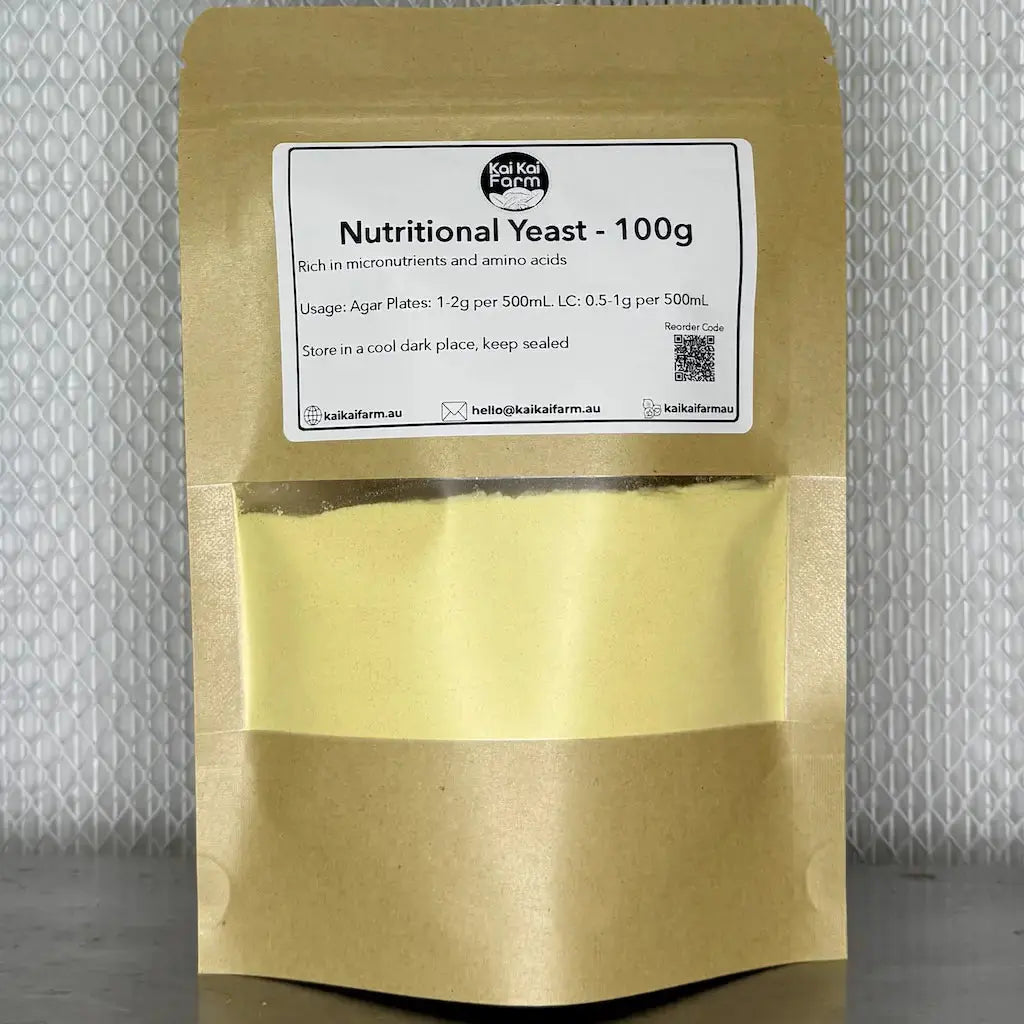
Most nutritional yeast sold for mycology comes as coarse flakes that clump in warm media and need vigorous stirring to dissolve. This is a fine powder — it disperses instantly in water and dissolves completely during the autoclave cycle without any pre-treatment. A genuinely uncommon format for this ingredient, and one that makes a real difference in a lab workflow.
What makes this nutritional yeast different
Fine powder — not flakes
Dissolves completely in the autoclaveNutritional yeast flakes are widely available but dissolve poorly in agar and liquid culture media. Undissolved particles create inconsistent nutrient distribution and can introduce variables you don’t want. This fine powder disperses uniformly in room-temperature water and dissolves completely during sterilisation — no clumping, no stirring, no pre-dissolving required. Add it directly to your dry ingredients and autoclave.
Deactivated / inactive yeast
Will not compete with myceliumThis is heat-killed Saccharomyces cerevisiae — permanently deactivated, not merely dormant. There is no live yeast activity that could interfere with or compete against your mycelium in agar or liquid culture. It survives the autoclave cycle as a pure nutritional substrate: all the compounds intact, no biological activity. Safe to add to media before sterilisation.
B-complex vitamin profile
Metabolic cofactors for fungal growthNutritional yeast is one of the richest natural sources of B-complex vitamins — B1, B2, B3, B5, B6, B7, B9 and B12. In fungal biology, B-vitamins act as metabolic cofactors: they’re required by the enzymes that drive energy production, cell division, and hyphal elongation. Malt extract provides carbohydrates for energy; B-vitamins are the spark plugs that make those enzymes work efficiently.
Complete amino acid source
Organic nitrogen that sugars can’t provideMycelium needs nitrogen to build proteins, cell walls and enzymes — it cannot synthesise these from carbohydrates alone. Nutritional yeast provides a complete profile of amino acids and peptides as organic nitrogen, directly bioavailable to the mycelium without requiring enzymatic breakdown first. This is why the difference between MEA alone and MEA with nutritional yeast is so visible in growth rate and hyphal density.
What you’ll notice
- Visibly thicker, denser mycelium on agar plates — the difference between a thin veil and a robust mat is clear within the first week
- Faster colonisation from the inoculation point — mycelium that has adequate nitrogen expands more aggressively and reaches plate edges sooner
- Denser liquid culture with more visible mycelial mass — LC jars that were previously showing light growth show noticeably heavier colonisation
- Cultures that are easier to observe and transfer — denser growth means sector boundaries are clearer and wedge cuts are more defined
- No clumping, no undissolved particles, no inconsistency batch to batch — the powder format delivers what flakes can’t
Why mycelium responds so strongly to nutritional yeast: Fungal mycelium is primarily protein and chitin — its cell walls, enzyme systems and reproductive structures are all nitrogen-intensive. Standard agar recipes based on malt extract and dextrose provide carbohydrates (carbon) as an energy source but are relatively poor in bioavailable nitrogen. Mycelium can extract some nitrogen from malt, but the process is enzymatically expensive. Nutritional yeast provides pre-formed amino acids and peptides that the mycelium can absorb directly, diverting more metabolic energy into growth rather than nutrient extraction. The result is faster colonisation and visibly denser hyphal networks.
Why “deactivated” matters for mycology specifically: Active baker’s yeast (Saccharomyces cerevisiae) is a competing organism in any culture media — it will consume sugars, produce CO² and alcohol, and create an environment that can inhibit or outcompete mycelial growth. Deactivated nutritional yeast has been heat-killed at temperatures that destroy all cellular activity while preserving the full nutritional payload. The autoclave cycle does not reactivate it. What enters your media is pure nutrition with zero biological competition.
How to use it
Add to media before sterilising — no pre-dissolving required.
Agar media — MEA, PDA, LMEA and variants
Add to dry ingredients before combining with water
Add the powder directly to your other dry ingredients (agar, malt extract) before adding water. Stir briefly, then autoclave as normal at 15 PSI / 121°C for 20 minutes. The powder fully dissolves during the cycle — no pre-mixing or warm water required. Start at 2g per litre if you’re new to enriched media; increase to 5g per litre for faster, denser growth once you’re comfortable with the results.
Enriched MEA recipe (per litre):
20g agar agar powder · 15g light malt extract · 2–5g nutritional yeast powder · 1L water
Liquid culture — LC jars and syringes
Dissolves in any LC recipe before sterilisation
Add the powder to your LC recipe before sterilising. It dissolves fully at sterilisation temperature, producing a clear to slightly amber-coloured liquid — this is normal and does not indicate contamination. Common LC base recipes to pair it with:
Malt extract LC
10–15g light malt extract + 2–5g nutritional yeast + 1L water
Honey LC
10g raw honey + 2–5g nutritional yeast + 1L water
Corn syrup LC
10g light corn syrup + 2–5g nutritional yeast + 1L water
All recipes:
Autoclave at 15 PSI / 121°C for 20–30 minutes. Inoculate when cooled to room temperature.
💡 Finding your dose
2g per litre — light enrichment
Good starting point. Noticeably thicker growth than unenriched MEA with minimal risk of over-enrichment. Suits most species and is a good default for isolation work where you want clean, visible growth.
5g per litre — heavy enrichment
Maximum growth rate and density. Best for aggressive colonisers (oysters, pioppino) and LC jars where you want high mycelial mass quickly. Not recommended for isolation plates where subtle growth differences matter.
How far does a bag go?
| Bag size | At 2g per litre | At 5g per litre | Typical use |
|---|---|---|---|
| 50g | 25 litres of media ~1,000 agar plates |
10 litres of media ~400 agar plates |
Hobbyist agar worker · occasional LC user · trying enriched recipes for the first time |
| 100g | 50 litres of media ~2,000 agar plates |
20 litres of media ~800 agar plates |
Regular lab workflow · multiple species in rotation · commercial cultivators · best value per gram |
Agar plate yield based on 40 plates per litre at 25mL per 90mm dish. LC jar yield: each 1L jar uses 2–5g.
Complete your agar and LC setup
Lab-grade, 1,000 g/cm² gel strength. The gelling agent for all your agar recipes. 100g bag yields 200–250 plates — pair with this nutritional yeast for enriched MEA.
The carbohydrate base for MEA and LC recipes. Pairs directly with nutritional yeast — malt provides the carbon, yeast provides the nitrogen. The complete media combination.
| Size | Best for |
|---|---|
| 50g | First-time users of enriched media · occasional agar work · pairs well with a 100g agar bag for a complete enriched MEA setup at similar cost |
| 100g | Regular lab workflow · multiple species and media types · best value per gram · enough for a year of consistent use at standard doses |




Hand-Grown on Tamborine Mountain
At Kai Kai Farm, we don't just sell kits and tonics—we use them every day. Founded by Quintin and Amy in the heart of the Scenic Rim, our mission is to make professional-grade mushroom cultivation and sustainable gardening accessible to everyone. From our no-spray gourmet mushrooms to our bio-active soil health range, every product is tested right here on the farm to ensure your growing journey is a success. When you shop with us, you’re supporting a local family business dedicated to a greener, more delicious planet.