


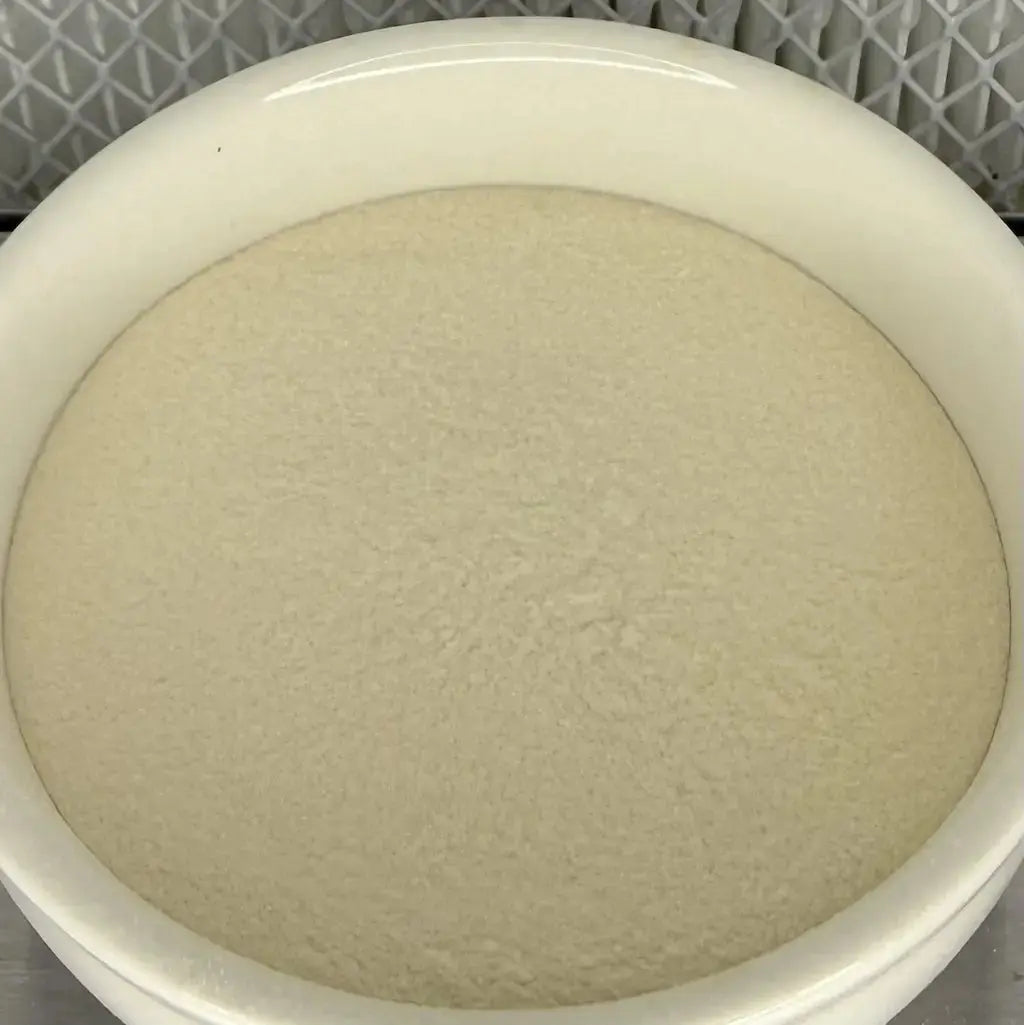
Agar Agar Powder
Agar Agar Powder
Couldn't load pickup availability
Most growers hit a ceiling when they rely on other people’s genetics. Agar Agar work is how you take control of your own.
Agar Agar is the medium that unlocks the laboratory side of mushroom cultivation — the tool that lets you germinate spores, clone fruiting bodies, isolate clean genetics, detect contamination before it reaches your substrate, and bank cultures for future grows. Once you work with agar, it becomes a permanent part of how you cultivate.
This is lab-grade agar powder sourced from Japan, packaged in Australia. Gel strength: 1,000 g/cm² — meaningfully firmer than standard food-grade agar (typically 700–900 g/cm²), giving you plates that hold up during transfers, cut cleanly for wedges and sectors, and stay stable across the full incubation period.
What makes this agar the right choice
1,000 g/cm² gel strength
Premium above standard gradeStandard food-grade agar typically gels at 700–900 g/cm². At 1,000 g/cm², this agar produces plates that are noticeably firmer — they hold their shape when you transfer wedges and sectors, resist cracking during manipulation, and stay stable across longer incubation periods without softening. The higher gel strength also means you can pour slightly thinner plates without compromising structural integrity.
Lab grade, Japanese source
Consistent purity, packaged in AustraliaSourced from Japan — the world’s benchmark for agar quality — and packed here in Australia. Lab grade means tightly controlled purity and consistency: no batch-to-batch variation in gel strength, no unexpected impurities affecting plate clarity, and no competing microbial load to compromise your cultures before you’ve even inoculated.
20g per litre — efficient and economical
200–250 plates per 100g bagAt 20g per litre of media solution, poured at 20–25mL per 90mm plate, a single 100g bag yields 200–250 petri dishes. The 200g bag extends to 400–500 plates. For context, that’s months of regular agar work from a single purchase. A little goes a very long way.
Resealable packaging
Stays fresh between poursAgar powder is hygroscopic — it absorbs moisture from the air and clumps if left exposed. The resealable pouch keeps the powder dry and free-flowing between uses, maintaining precise measurement accuracy for every pour. Squeeze out excess air when resealing, and it will remain in perfect condition for years.
What agar work makes possible
- Seeing contamination on a plate before it destroys an entire bag of substrate — agar is your early warning system
- Selecting the fastest, densest, most vigorous mycelium sectors from a mixed culture and isolating the genetics you want
- Cloning high-performing fruiting bodies — taking a tissue sample from an exceptional specimen and capturing those genetics permanently
- Banking cultures in the fridge for months, removing the dependency on buying new spawn for every grow
- Germinating spores from a print under controlled conditions and observing growth from day one
- The dramatic improvement in contamination rates that comes from working with clean, isolated cultures rather than bulk-inoculated substrate
What agar actually is — and why gel strength matters: Agar is a complex polysaccharide extracted from red algae (primarily Gelidium and Gracilaria species). Unlike gelatin, it is plant-derived, sets at room temperature and remains solid up to around 85°C — which means it stays firm during incubation and doesn’t melt when plates warm up near a heat mat. When dissolved in water and cooled, it forms a transparent, porous gel matrix that allows gas exchange (oxygen in, CO² out) while preventing liquid movement — creating ideal conditions for surface mycelium growth.
Gel strength (g/cm²) in practical terms: Gel strength is measured by the weight required to rupture the gel surface — higher is firmer. At 1,000 g/cm², this agar produces plates that withstand the physical manipulation of mycology work: scalpel cuts through cultures without tearing, wedge transfers lift cleanly, and sectors can be moved intact. Lower gel strength agar (700–800 g/cm²) produces softer plates that can tear during transfers or deform in warm conditions — a minor inconvenience for casual use but a meaningful problem when you’re doing precision isolation work.
Agar media recipes
All recipes per 1 litre of water · yields 40–50 × 90mm petri dishes · autoclave at 15 PSI / 121°C for 20 minutes
MEA — Malt Extract Agar
The standard. Suitable for almost every species and application.
Per litre
20g agar agar powder
15g light malt extract
1L water
The workhorse of mycology media. Malt extract provides a complete carbohydrate and trace mineral profile that supports vigorous mycelial growth across almost every cultivated species. Use MEA as your default medium for culture expansion, spore germination and general agar work.
Good for: All oyster varieties · lion’s mane · shiitake · pioppino · chestnut · general culture expansion
PDA — Potato Dextrose Agar
Natural starch-based medium. Excellent for cloning and tissue work.
Per litre
20g agar agar powder
200g potatoes (peeled)
20g white sugar or dextrose
Top up to 1L water
Boil 200g diced potato in 1L water for 20 minutes. Strain well, keeping the liquid. Top up to 1L. Add sugar and agar. Autoclave as normal. PDA’s starchy, natural nutrient profile is particularly suited to tissue culture from fresh fruiting bodies, and many cultivators prefer it for species that can be finicky on malt-based media.
Good for: Fruiting body cloning · shiitake · reishi · species that prefer lower-nitrogen media
LMEA — Light Malt Extract Agar
Low-nutrition isolation medium. Preferred for sector isolation and slow species.
Half the malt content of standard MEA. The reduced nutrition slows both mycelium and competing organisms, giving you more time to observe and isolate clean sectors before contamination overtakes the plate. Preferred by experienced cultivators for isolation work where speed of growth is less important than clarity of observation.
Good for: Sector isolation · slow colonisers · spore germination · detecting mixed cultures · enoki · reishi
How to prepare your plates
Mix → autoclave → cool → pour → set → store
Where agar fits in your cultivation workflow
| Application | What you’re doing | Best media |
|---|---|---|
| Spore germination | Germinating spores from a print or syringe to observe and select germination points | MEA or LMEA |
| Culture expansion | Growing out mycelium from a small inoculation point to fill plates for grain transfers | MEA |
| Contamination screening | Plating a sample to check for bacterial or fungal contamination before committing to substrate | MEA (bacteria visible) or LMEA |
| Sector isolation | Identifying and cutting the fastest, densest mycelium sectors from a mixed or contaminated culture | LMEA (slower growth = easier observation) |
| Fruiting body cloning | Taking internal tissue from a fresh mushroom and growing it out to capture and preserve genetics | MEA or PDA |
| Culture banking | Storing genetics long-term in the fridge between grows, eliminating dependency on purchased spawn | MEA or LMEA (refrigerated) |
How many plates per bag?
| Bag size | Litres of media | Plates at 20mL/plate | Plates at 25mL/plate |
|---|---|---|---|
| 100g | 5 litres | ~250 plates | ~200 plates |
| 200g | 10 litres | ~500 plates | ~400 plates |
Based on 20g agar per litre of media solution, poured into 90mm petri dishes. Thicker pours (25mL) extend plate depth and shelf life; thinner pours (20mL) maximise yield and suit short-term use.
Storage
Choosing your size
| Size | Plates | Best for |
|---|---|---|
| 100g | 200–250 plates | Starting out with agar work · hobbyist growers · enough for a year of regular home lab use |
| 200g | 400–500 plates | Established lab workflows · multiple species in rotation · commercial cultivators maintaining culture libraries |
Complete your agar setup
The nutrient source for MEA and LMEA. Sized to match these agar bags — 100g LME pairs perfectly with a 100g agar bag for a complete plate-pouring setup.
Add 2–5g per litre to MEA to boost nitrogen content and drive faster, denser mycelial growth. The upgrade for growers who want more from their plates.




Hand-Grown on Tamborine Mountain
At Kai Kai Farm, we don't just sell kits and tonics—we use them every day. Founded by Quintin and Amy in the heart of the Scenic Rim, our mission is to make professional-grade mushroom cultivation and sustainable gardening accessible to everyone. From our no-spray gourmet mushrooms to our bio-active soil health range, every product is tested right here on the farm to ensure your growing journey is a success. When you shop with us, you’re supporting a local family business dedicated to a greener, more delicious planet.