



Black Agar Pre-Mix — MYA with Activated Charcoal
Black Agar Pre-Mix — MYA with Activated Charcoal
Couldn't load pickup availability

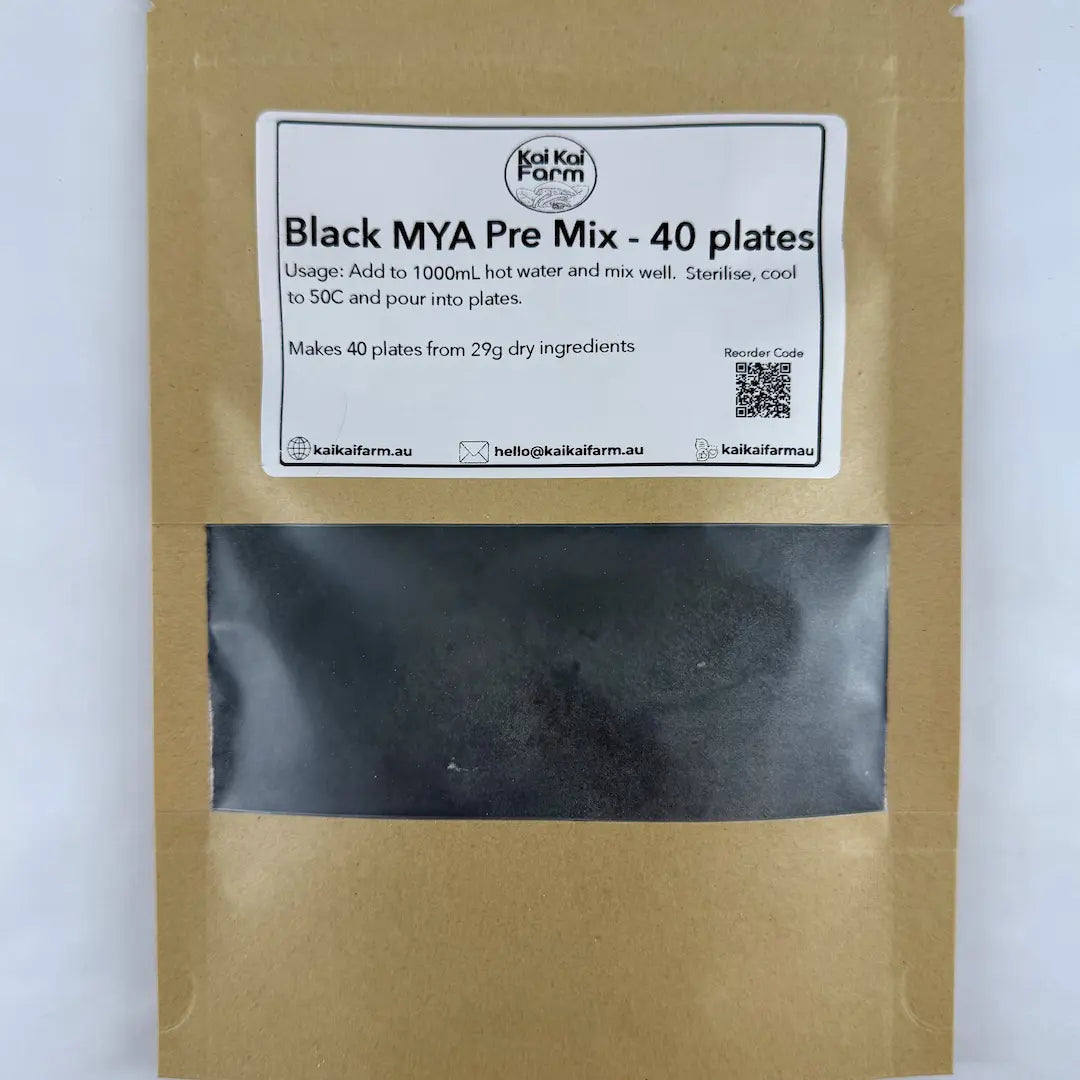
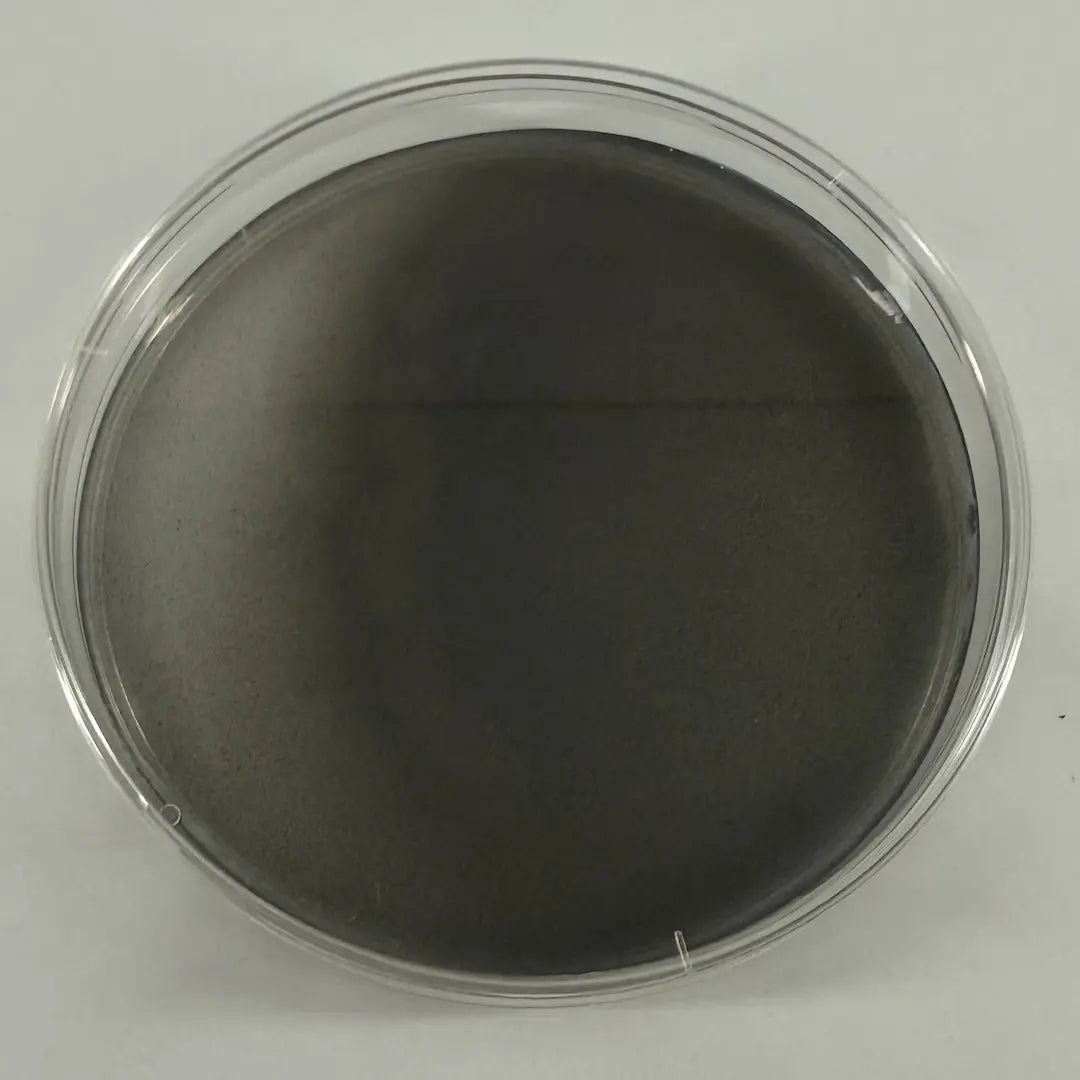
See every hypha. Black agar makes your mycelium impossible to miss.
White mycelium on pale amber agar is a squinting exercise. Sectoring, rhizomorphic edges, the first faint bloom of a contaminant — all of it disappears into the background. This is a full malt yeast agar (MYA) formula with activated black charcoal blended through it, so the medium pours a deep matte black and every strand of growth reads in high contrast. Weighed, blended and packed on our organic farm on Tamborine Mountain, dispatched from Queensland. As far as we can find, it’s the first black agar pre-mix made in Australia — until now you were importing pre-poured plates or blending charcoal into your own mix by hand.
What’s in the bag
Extracted from red seaweeds (Gracilaria and Gelidium). Sets firm at room temperature, holds its shape under a scalpel, and contains no animal ingredients. Blended at 2% w/v — firm enough to cut clean wedges for transfer without tearing.
High in maltose, plus the proteins and nitrogenous compounds fungi draw on for energy. Light malt rather than dark keeps the base medium from muddying the charcoal black and avoids the caramelised notes that can slow some species.
A fine, highly porous carbon. Two jobs: it turns the plate matte black for contrast, and its enormous internal surface area adsorbs phenolics and inhibitory metabolites released into the medium — the same reason plant tissue culture labs have used charcoal media for decades. Blended at 0.3% w/v: fully opaque without going gritty.
Deactivated Saccharomyces cerevisiae. Supplies free amino acids and the B-complex vitamins (thiamine, riboflavin, niacin, biotin, B6) that malt extract alone doesn’t cover. This is the “Y” in MYA, and it’s why recovery from a slow or stressed culture is noticeably quicker than on plain MEA.
What you’ll notice
- Sectors jump out. Isolating a fast rhizomorphic sector from a slow tomentose one becomes a matter of looking, not guessing. This is the single biggest reason people switch.
- Contamination shows early. A pale bacterial sheen or the first grey fuzz of Trichoderma reads against black long before it would against amber.
- Plates photograph properly. If you document strains or sell cultures, black plates shoot far better than translucent ones.
- Clean, even set. Poured at the ratios below, plates set flat and matte with no surface sheen, and cut without crumbling.
- No dyes. The colour is carbon, not food colouring.
Activated carbon works by adsorption: its pore structure traps organic molecules on contact. In culture media that includes phenolic compounds and metabolic by-products which accumulate around a growing colony and can inhibit it. Mycologists have used charcoal-supplemented media since at least the 1970s for exactly this reason, particularly with tissue clones and difficult wild collections where browning and stalling are common.
To be straight with you: charcoal is not an antibiotic and it will not sterilise anything. Some sellers describe it that way. It adsorbs; it does not kill. Good sterile technique, a still air box or flow hood, and a properly run pressure cooker still do the actual work. What charcoal gives you is contrast and a cleaner chemical environment around the colony.
Mix rates
We list both the pack weight and the water volume, so you can pour to your own preference and work out plate counts yourself. Our stated counts assume a generous 25 mL pour into a 90 mm dish — thick enough to resist drying out over a long incubation, and forgiving if your hand isn’t steady yet. Pour thinner at 15 mL and you’ll get roughly 60% more plates per pack.
| Variant | Pack weight | Water | Plates @ 25 mL | Plates @ 15 mL |
|---|---|---|---|---|
| 20 PLATES | 29 g | 500 mL | 20 | 33 |
| 40 PLATES | 58 g | 1 L | 40 | 66 |
| 80 PLATES | 116 g | 2 L | 80 | 133 |
How to use it
Tip the full pack into the matching volume of water in a heatproof bottle or flask. A 1 L media bottle suits the 40 Plate mix; use a 2 L flask for the 80.
Stir or swirl thoroughly. Charcoal settles — you want it fully suspended before it goes into the cooker.
Cap loosely. Pressure cook at 103 kPa (15 psi) for 20 minutes at 121 °C.
Cool to around 50 °C — hot enough that you can just hold the vessel. Swirl gently once more to re-suspend the charcoal, then rest 30 seconds to let bubbles rise.
Pour in front of a flow hood or inside a still air box. Roughly 25 mL per 90 mm dish. Leave lids ajar 10–15 minutes to set, then seal.
Charcoal is heavier than the medium and will drift to the bottom of the vessel while it cools. If your first plates come out jet black and the last few come out grey, that’s settling, not a bad batch. Swirl between every three or four pours and they’ll all match.
Dry mix: reseal the pouch and keep it cool, dark and dry. Malt extract is hygroscopic and will cake if it takes on moisture. Stored properly the mix keeps for 12 months. Poured plates: refrigerate sealed and use within 30 days; bring to room temperature for 30–60 minutes before inoculating so condensation doesn’t form on the surface.
Keep out of reach of children and animals. This is a laboratory culture medium, not a food product. Charcoal powder is very fine — avoid inhaling the dry mix and blend it in still air. For mushroom cultivation and microbiology use only.
Ingredients
Agar agar powder (Gracilaria / Gelidium seaweed), light dry malt extract, organic activated charcoal powder, non-GMO deactivated nutritional yeast (Saccharomyces cerevisiae). Nothing else — no dyes, no fillers, no antibiotics.
Pouring your first plates? You’ll also want Parafilm M pre-cut strips for sealing, and a still air box to pour inside.
Kai Kai Farm is a family-run certified organic farm on Tamborine Mountain, in Queensland’s Scenic Rim. We grow gourmet and medicinal mushrooms, and every culture we run starts on a plate we poured ourselves. This mix is the one we use — we blended it because we got tired of hunting for sectors on pale agar, and we’re selling it because nobody in Australia was. Weighed, blended and packed here on the farm, dispatched from Queensland. If you have questions about agar technique or anything else in your lab, get in touch. We’re growers, not just suppliers.

