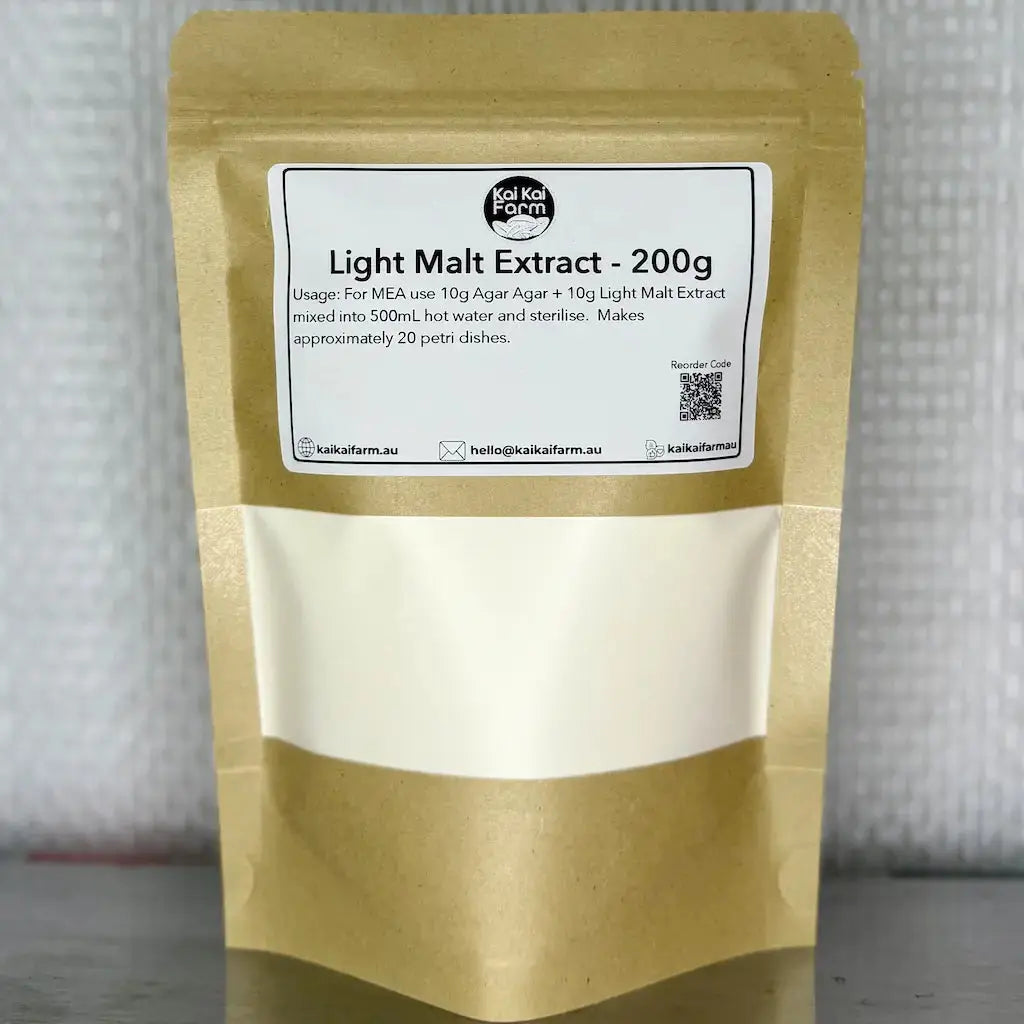

Light Malt Extract
Light Malt Extract
Couldn't load pickup availability
Most homebrew stores sell malt extract. Most of it contains hops. Hops inhibit fungal growth. This doesn’t.
Light Malt Extract is the carbohydrate foundation of the two most important media in mushroom cultivation — Malt Extract Agar (MEA) and malt-based liquid culture. It provides mycelium with a complex mix of sugars, amino acids, B-vitamins and trace minerals that simple sugars like honey, dextrose or table sugar cannot match.
Ours is sourced from Australia, fully unhopped, and the light variety specifically — the only form suitable for mycology. Dry powder, not sticky liquid. Everything it should be, nothing it shouldn’t.
What makes this the right malt extract for mycology
100% unhopped
Safe for all mycology applicationsHops contain alpha acids (humulone, cohumulone) and beta acids with potent antifungal activity — by design, to protect fermenting beer from microbial contamination. Those same compounds inhibit or kill mycelium in agar and liquid culture media. This extract contains no hop additions at any stage of production. Confirmed unhopped, confirmed safe for mycology use.
Light, not dark
Preserves the full nutritional profileDark malts are kilned at high temperatures, producing Maillard reaction compounds and melanoidins that can inhibit fungal enzyme activity and slow colonisation. Light malt is minimally kilned, preserving a clean, complex nutritional profile of maltose, glucose, amino acids and B-vitamins. MEA made with light malt also produces clearer, more amber-coloured plates — making contamination easier to spot than on the dark, opaque plates dark malt produces.
Australian sourced
Local supply chain, reliable qualitySourced from Australian producers rather than imported. Consistent batch-to-batch quality, no long supply chain variables, and shorter time from production to your hands. Australian malted barley is world-class — the same base ingredient that underpins one of the country’s most respected brewing industries.
Dry powder, not liquid
Precise, clean and long shelf lifeLiquid malt extract has the consistency of molasses — sticky, difficult to measure accurately, messy to pour and prone to contamination once opened. Dry powder malt extract weighs precisely, dissolves cleanly in water, and has a significantly longer shelf life when stored correctly. Measure by weight, not by eye.
What you’ll notice
- Agar plates with a clear, pale amber colour that makes contamination easy to identify at a glance
- Strong, consistent mycelium colonisation from inoculation point to plate edge — no thin or patchy growth
- Liquid culture with visible mycelial mass and consistent growth — predictable results batch after batch
- Faster grain colonisation when malt-based LC is used to inoculate grain spawn — the grain-conditioning effect
- Powder that measures precisely by weight and dissolves cleanly — no sticky residue, no waste
Why malt extract outperforms simple sugars as a media ingredient: Honey, dextrose, corn syrup and table sugar all provide glucose or fructose as an energy source — straightforward carbon fuels that mycelium can consume directly. Light malt extract provides all of that, plus considerably more. Malted barley contains maltose (a disaccharide that mycelium digests slightly more slowly than glucose, providing a sustained energy release), naturally occurring amino acids and peptides as organic nitrogen, B-vitamins that function as metabolic cofactors, and trace minerals including zinc, manganese and selenium. The result is a richer nutritional environment that supports faster growth, denser hyphal networks and more resilient cultures than simple sugar media can produce.
The grain-conditioning effect: When mycelium is grown in malt-based liquid culture (malt extract being derived from malted barley), it develops the enzymatic toolkit for digesting barley starches and carbohydrates. When that LC is then used to inoculate grain spawn — which is also typically barley, rye or wheat-based — the mycelium is already enzymatically primed for the substrate. This results in noticeably faster grain colonisation compared to LC prepared with simple sugars, and is one of the reasons experienced cultivators favour malt-based LC over honey or dextrose alternatives.
How to use it
Three core applications — agar, liquid culture and enriched agar.
MEA — Malt Extract Agar
Standard general-purpose agar for most species and applications
Per litre: 15g light malt extract · 20g agar agar powder · 1L water
Combine dry ingredients, add water, autoclave at 15 PSI / 121°C for 20 minutes. Pour at ~50°C into 90mm petri dishes at 20–25mL per plate. MEA at this concentration is the default medium for culture expansion, spore germination and general agar work across almost all cultivated species.
LMEA — Light Malt Extract Agar
Reduced-nutrition medium for isolation and sector selection
Per litre: 10g light malt extract · 20g agar agar powder · 1L water
Half the malt content of standard MEA. The lower nutrient level slows growth of both mycelium and competing organisms, giving you more time to observe sector boundaries, isolate clean genetics and identify contamination before it overtakes the plate. Preferred for isolation work, spore germination and species that show more distinct growth patterns on leaner media.
Malt extract liquid culture
The grain-conditioning LC for faster grain colonisation
Per litre: 10–15g light malt extract · 1L water · optional: 2–5g nutritional yeast powder for added nitrogen
Combine, autoclave at 15 PSI / 121°C for 20–30 minutes, cool to room temperature before inoculating. Use 10g per litre for a lighter LC that colonises more slowly but clearly; 15g per litre for faster, denser growth. Adding nutritional yeast powder at 2–5g per litre significantly increases mycelial density — the combination of malt (carbon) and nutritional yeast (nitrogen) is the most effective pairing for LC work.
How far does a bag go? Storage
Complete your agar and LC setup
Lab-grade, 1,000 g/cm² gel strength. Pairs directly with this malt extract for MEA and LMEA. A 100g agar bag + 100g LME covers the same number of plates at equivalent cost.
The nitrogen source that pairs with this carbon source. Add 2–5g per litre to MEA or LC for faster, denser mycelial growth. The complete media combination for serious agar work.
Benefits
Benefits
How do I use it?
How do I use it?
Available Sizes
Available Sizes
Delivery Information
Delivery Information
- We ship from Tamborine Mountain, QLD using either AusPost or Aramex
- Fast dispatch within 1-2 business day (excluding Fridays) with express post options available