



Oyster Mushroom 'Black Pearl King' - 2.2KG Ready To Fruit Block
Oyster Mushroom 'Black Pearl King' - 2.2KG Ready To Fruit Block
Couldn't load pickup availability


Thick, scallop-cut stems and caps so dark they read black on the plate.
Black Pearl King (Pleurotus spp.) is a Japanese hybrid — King Oyster (P. eryngii) crossed with Pearl Oyster (P. ostreatus). It takes the thick stem, dense flesh and bold savoury depth from its king parent, and the fast colonisation and easy side-fruiting from its pearl parent. You get King Oyster texture on the plate without King Oyster fussiness in the grow room.
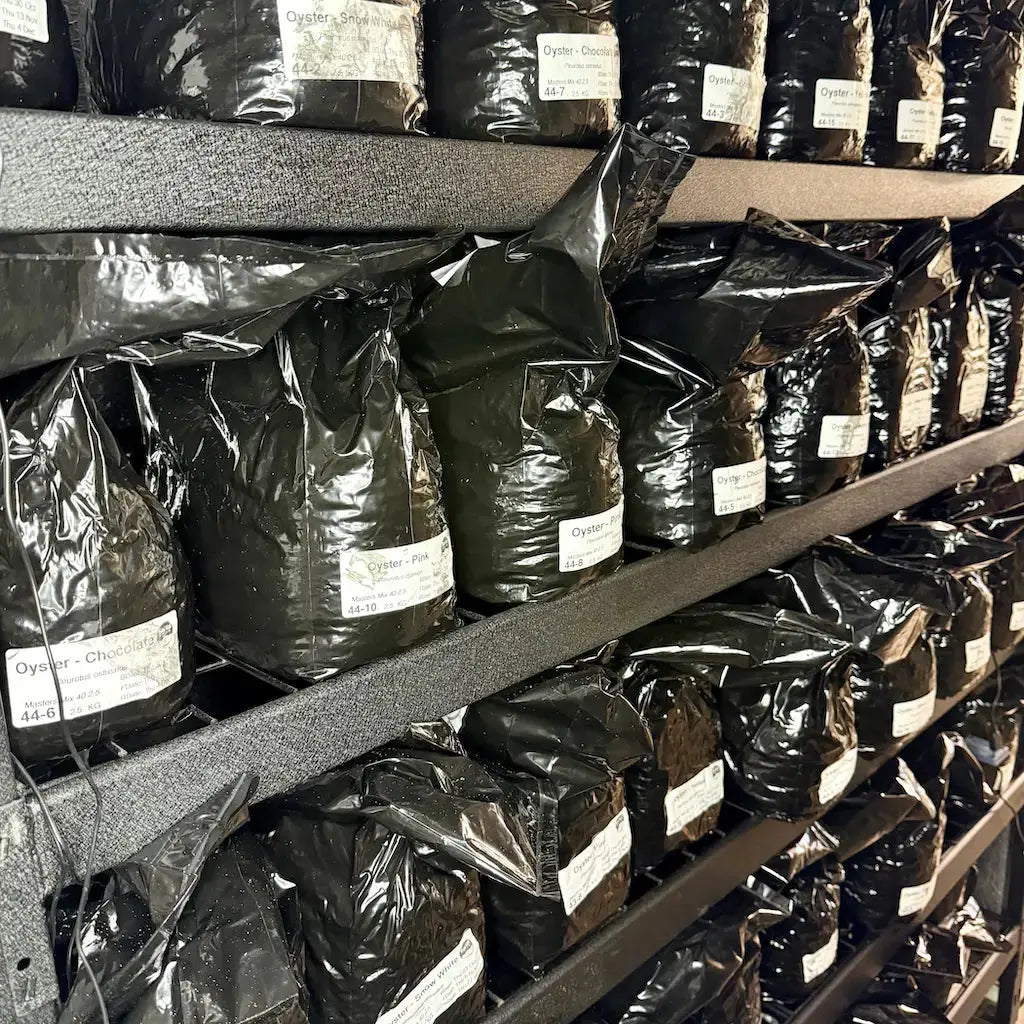
This is a 2.2 KG ready-to-fruit block: fully colonised, sealed, and ready to pin as soon as you cut it open. Grown, sterilised and colonised right here on Tamborine Mountain on our own hardwood + soy hull Masters Mix — not imported, not repackaged, not resold. Cut an X, keep it cool and humid, and the block does the rest.
Why growers and chefs chase this one
King Oyster stems, oyster-easy growing
Meaty stems. None of the eryngii fuss.True King Oyster is notoriously demanding to fruit well. This hybrid inherits the thick, dense, caramelising stem — cut it into rounds and it sears like a scallop — while fruiting from a simple side cut the way every other oyster in our range does. That combination is the whole point of the cross.
Caps that read near-black
Darkest in the cold.Deep charcoal to almost black, with rippling cap margins that lighten as they mature. Colour is driven by cool temperatures and consistent light — fruit it at the low end of the range and you get the dramatic near-black clusters that sell themselves on a market table or a menu.
You decide the shape it grows
More air, wider caps. Less air, thicker stems.Airflow is a dial on this variety in a way it isn't on the others. Restrict fresh air and the stems elongate and thicken into a king-style column. Open it right up and the caps expand into a broad, layered oyster fan. Same block, two very different products — chosen before you start fruiting.
Grown and colonised on-farm
Not repackaged. Grown here.Every block is mixed, sterilised and colonised at Kai Kai Farm on our own hardwood + soy hull Masters Mix — the same substrate we fruit commercially. Verified contamination-free, consistent block to block, and packed to order rather than sitting in a warehouse.
What you’ll notice
- Stems with real substance — thick enough to cut into rounds and sear, holding their shape in the pan
- Charcoal to near-black caps with rippled edges — the most striking cluster in the range
- A firm, resilient bite and bold, earthy flavour with a faint sweetness and a hint of smoke
- Noticeably better fridge life than a standard grey oyster — the dense flesh holds up
- Control you don’t get elsewhere — adjust airflow and steer the harvest toward stems or caps
Why the hybrid behaves the way it does: P. ostreatus is a vigorous wood decomposer — fast to colonise, forgiving, and happy to pin from an opening in the bag. P. eryngii is the opposite: a grassland species that in the wild feeds on plant roots rather than wood, which is why it demands so much more control in cultivation, but also why it builds that famously dense, low-moisture flesh. Black Pearl King is a cultivar selected to carry the eryngii fruit structure on the ostreatus growth habit. The Masters Mix underneath it does the rest — hardwood supplies the lignocellulosic backbone, soy hulls add readily available nitrogen and protein, and the extra nitrogen is what fuels thick stems rather than thin, watery ones.
Why airflow changes the shape: Mushrooms read CO₂ as a depth cue. When CO₂ builds up around the block, the fungus behaves as though it’s buried and pushes the stem upward to reach clear air — stems elongate and thicken, caps stay tight. When fresh air is plentiful and CO₂ falls, it reads the surface as reached and invests in cap expansion instead. Most varieties treat this as a fault to be avoided; on Black Pearl King it’s a deliberate lever. Decide which form you want before you start fruiting, then set your airflow to match and leave it there.
Why cool and bright makes it black: Cap pigmentation in this cultivar develops most intensely at the low end of the fruiting range and under a consistent daily light cycle. Fruit it warm or in a dim corner and the caps come out a washed-out grey-brown — still perfectly good eating, but without the drama that makes this variety worth growing. Cool, bright and indirect is the recipe.
How to fruit your block
Site it cool → cut an X → pick your airflow → keep it humid → harvest pre-curl → rest → re-flush
Fruiting conditions at a glance
Step by step
What to expect from each flush
🍳 In the kitchen
Bold, earthy and faintly sweet with a whisper of smoke, and a firm, resilient bite that holds up where a standard oyster would collapse. Cut the stems into thick rounds and sear them hard in a dry pan before adding butter — they caramelise and eat like scallops. Tear the caps into big pieces for grain bowls, tacos and stir-fries where you want each piece to carry visual weight. It takes high heat, long roasting and grilling far better than any other oyster in our range, and the near-black caps hold their colour on the plate.
Storage & handling
Perfect for
What’s inside the block
~2.2 KG block, sterilised and fully colonised with Black Pearl King mycelium before dispatch. No fillers, no additives — just substrate and mycelium.
More ready-to-fruit blocks
The Kai Kai Farm story
Kai Kai Farm is a family operation on Tamborine Mountain in Queensland’s Scenic Rim. We grow gourmet mushrooms commercially — oysters, lion’s mane, pioppino, chestnut — and we sell blocks cut from the same production we fruit ourselves.
We’re growers, not resellers. Every block is mixed, sterilised and colonised here on the mountain, using methods refined over years of commercial gourmet and medicinal mushroom production. What arrives at your door is genuinely fresh — inoculated, colonised and packed to order, with verified contamination-free cultures and full transparency from substrate to shelf.
Black Pearl King is one of the more interesting things we grow — a variety that rewards a grower who pays attention, and one our restaurant customers notice the moment it lands on the bench. Whether you’re fruiting a single block in a cool spare room or running a rack of them through a market garden, this is the block we grow ourselves.

