



Turkey Tail Mushroom - 2.2KG Ready To Fruit Block
Turkey Tail Mushroom - 2.2KG Ready To Fruit Block
Couldn't load pickup availability


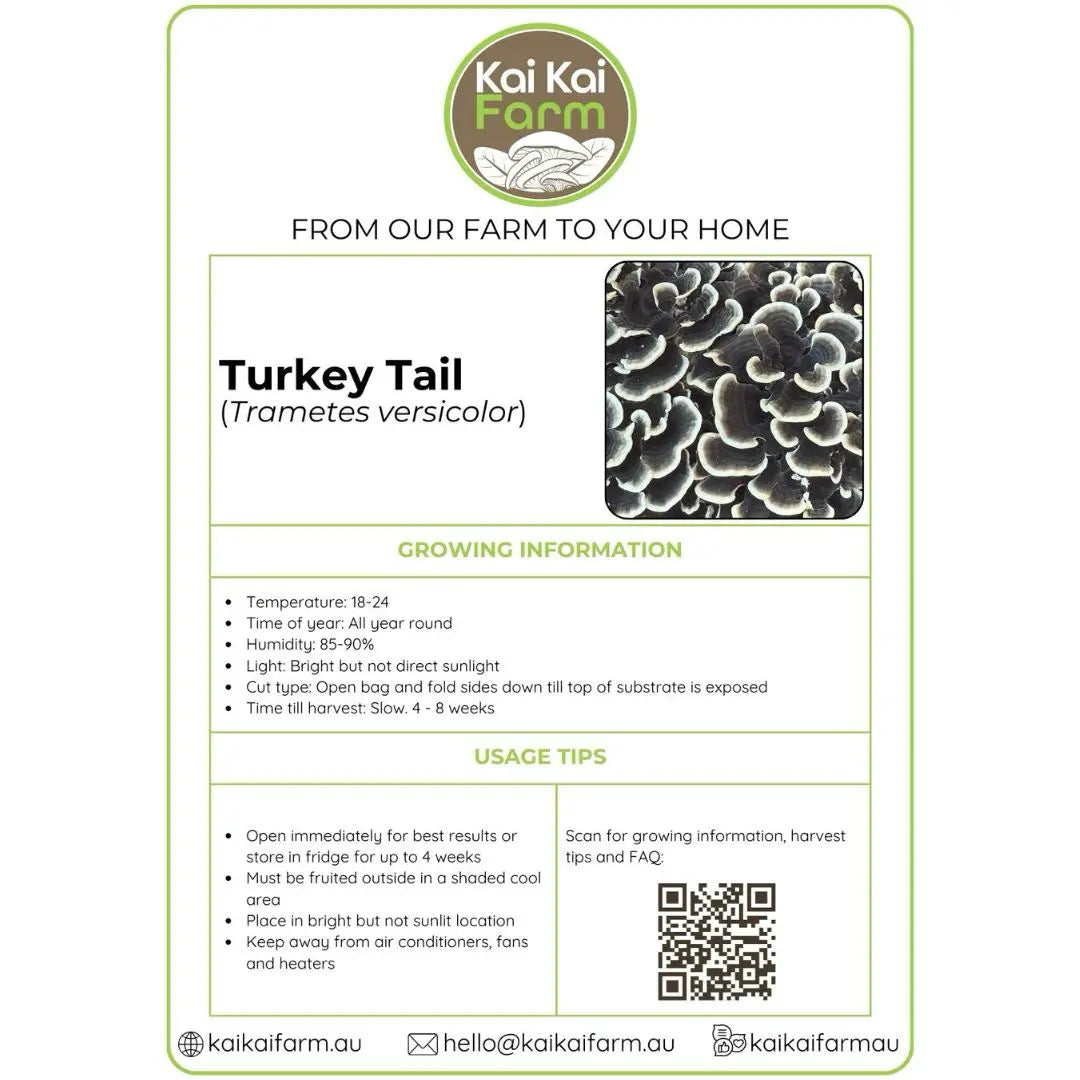
Banded shelves of rust, cream and slate — grown on a clean block, not foraged off a fallen log.
Turkey Tail (Trametes versicolor) is one of the most widespread wood-decay fungi on earth, and one of the most studied medicinal mushrooms in the world. In Australian bushland you'll find it fanned across fallen branches in overlapping, multicoloured tiers. Like Reishi, it isn't a mushroom for the pan: the thin, leathery brackets are dried and simmered into tea and broth.
This is a 2.2 KG ready-to-fruit block: fully colonised, sealed, and ready to grow as soon as you cut it open. Grown, sterilised and colonised right here on Tamborine Mountain on hardwood with organic certified wheat bran — not imported, not repackaged, not resold. Cut a few horizontal slits, keep it humid and bright, and over the following weeks the brackets fan out from the block just as they would from a log in the forest.
Why grow your own Turkey Tail
Know exactly what you're brewing
No foraging. No look-alikes.Wild Turkey Tail shares the log with several look-alikes, and foraged brackets carry whatever the wood and the roadside did. A block grown from a known culture on clean, sterilised substrate gives you true Trametes versicolor, every time, from a source you can trace.
Tea and broth, not the pan
Dry it, simmer it, sip it.Turkey Tail is too tough and leathery to eat. It's harvested, dried, and slowly simmered into a mild, earthy tea or added to stock. Thin brackets dry quickly and store for a year or more, so one block keeps a cupboard stocked well beyond harvest.
A warm-weather grower
Made for a Queensland spring and summer.Our strain fruits at 18–25°C, which suits subtropical Queensland through the warmer half of the year. When the cool-weather blocks in our range slow down, Turkey Tail and Reishi pick up.
Grown and colonised on-farm
Not repackaged. Grown here.Every block is mixed, sterilised and colonised at Kai Kai Farm on hardwood and organic certified wheat bran. Verified contamination-free, consistent block to block, and packed to order rather than sitting in a warehouse.
What you'll notice
- A firm, white block that may show tan or brown patches and a few amber droplets on the surface. That's normal for Turkey Tail, not contamination
- Small white knobs pushing out of the slits within 1–3 weeks of cutting
- Those knobs flattening into thin, overlapping fans, with the colour bands filling in from the base outward
- Velvety upper surfaces and a fine, pale pore layer underneath, the tell-tale mark of true Turkey Tail
- 200–300 g fresh on the first flush, with up to 3 flushes from one block
Why hardwood with a light bran supplement: Turkey Tail is a white-rot fungus, one of the few organisms on earth that can fully break down lignin, the tough polymer that holds wood together. In the wild it lives on low-nitrogen dead wood, so we keep its diet close to that: Australian hardwood with just 10% organic certified wheat bran. That's enough nitrogen and minerals to fuel a strong first flush without pushing the soft, fast growth a richer mix would. A small addition of gypsum and chalk (3%) supplies calcium and keeps the block's pH steady over the weeks it takes to fruit.
Why fresh air and light make the colour: Like Reishi, Turkey Tail reads carbon dioxide as a cue. In still, stale air it stays as thick, knobbly lumps that never open out. With steady fresh air it flattens into the thin, layered fans it's named for. Light matters too: the concentric bands of colour (versicolor means "of varied colours") develop most strongly with bright, indirect light, so a well-lit block gives the boldest banding.
How to tell it's the real thing: Flip a bracket over. True Turkey Tail has a pale underside covered in tiny pores, like the surface of a fine sponge. Its most common look-alikes have a smooth underside. On a block grown from our own spawn there's no guesswork, but it's a handy check if you ever forage.
How to fruit your block
Site it warm and bright → cut horizontal slits → keep it humid → give it fresh air → wait for the bands → harvest and dry
Fruiting conditions at a glance
Step by step
What to expect from each flush
🍵 Brewing your Turkey Tail
Brush off any substrate, then dry the brackets whole on a rack or in a dehydrator at 40–50°C until they snap rather than bend. Stored in an airtight jar out of light, dried Turkey Tail keeps for a year or more. To brew, break or snip 10–15 g of dried brackets into small pieces and simmer gently in 1 litre of water for 45–60 minutes, then strain. The result is mild and earthy, far less bitter than Reishi, and pairs well with ginger, cinnamon or a squeeze of lemon. It also makes a good base for soup stock. Turkey Tail isn't eaten fresh: it's far too tough to chew.
Storage & handling
Perfect for
What's inside the block
~2.2 KG block, sterilised and fully colonised with Turkey Tail mycelium before dispatch. No fillers, no additives, just substrate and mycelium.
More ready-to-fruit blocks
The Kai Kai Farm story
Kai Kai Farm is a family operation on Tamborine Mountain in Queensland's Scenic Rim. We grow gourmet and medicinal mushrooms commercially, including oysters, lion's mane, pioppino, chestnut, shiitake, reishi and turkey tail, and we sell blocks cut from the same production we fruit ourselves.
We're growers, not resellers. Every block is mixed, sterilised and colonised here on the mountain, using methods refined over years of commercial gourmet and medicinal mushroom production. What arrives at your door is genuinely fresh: inoculated, colonised and packed to order, with verified contamination-free cultures and full transparency from substrate to shelf.
Turkey Tail is one of the most familiar brackets in Australian bushland. These blocks give you the same species from a clean, known culture on sterilised substrate, grown the way we grow our own. Whether you're fruiting one block on a bright verandah or stocking a tea cupboard for the year, this is the block we grow ourselves.

