Most mushrooms collapse in the pan. Chestnut holds its crunch.
Chestnut (Pholiota adiposa) grows in dense clusters of golden-brown, scaly-capped mushrooms on slender stems, with a firm, crunchy bite and a rich, nutty, earthy flavour that deepens the longer you cook it. Where softer varieties turn to mush under high heat, chestnut keeps its texture — which is exactly why chefs reach for it in stir-fries, braises and anything that needs a mushroom with backbone.
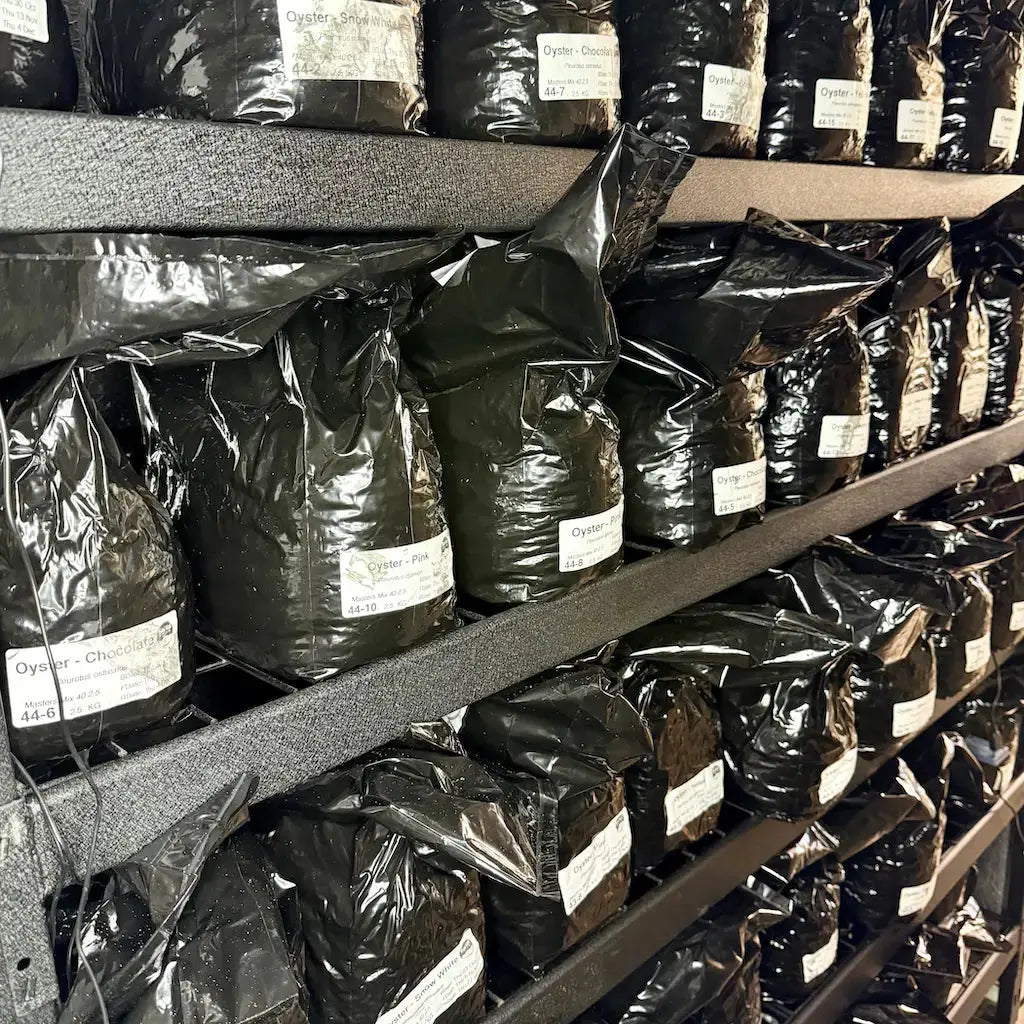
This is a 2.2 KG ready-to-fruit block: fully colonised on our own hardwood + soy hull Masters Mix and ready to pin once you cut it open. It’s a slower, cooler grow than the oysters — a patient, deliberate mushroom that rewards you with something few home growers have ever tried. Grown, sterilised and colonised right here on Tamborine Mountain.
Why growers and chefs seek chestnut out
Holds its crunch in the pan
Texture that survives high heat.
This is chestnut’s defining trait. Firm, meaty and genuinely crunchy, it holds its shape and bite through stir-frying, braising and roasting — where a softer mushroom would wilt to nothing. If you want a mushroom that eats like an ingredient rather than a garnish, this is it.
Rich, nutty, earthy flavour
Deeper than an oyster.
A properly savoury, nutty flavour that intensifies with cooking — closer to the earthiness of a wild forest mushroom than the mild sweetness of an oyster. It stands up to bold companions: soy, garlic, chilli, butter and slow braises all bring the best out of it.
A patient, cool-season grow
Cool-weather · 13–18°C.
Chestnut fruits in cooler conditions than most, making it a rewarding autumn and winter grow — and a way to keep producing when warm-loving varieties slow down. It takes a little longer and a cold nudge to pin, but the result is worth the patience.
Grown and colonised on-farm
Not repackaged. Grown here.
Every block is mixed, sterilised and fully colonised at Kai Kai Farm on our own hardwood + soy hull Masters Mix — a five-week incubation for chestnut before it ever ships. Verified contamination-free, consistent block to block, and packed to order rather than sitting in a warehouse.
What you’ll notice
-
Dense clusters of golden, scaly-capped mushrooms on slender stems
-
A firm, crunchy bite that holds up to high-heat cooking — no collapsing, no sogginess
-
A rich, nutty, earthy flavour that deepens the longer you cook it
-
A cool-season grow that fruits when many warm-loving varieties won’t
-
The satisfaction of a slower, more deliberate mushroom — and a variety few home growers have tried
Why Masters Mix suits chestnut:
Chestnut is a wood-loving species that responds well to moderate supplementation. The hardwood fraction provides the lignocellulosic backbone — cellulose, hemicellulose and lignin — that the mycelium is built to digest, while the soy hull fraction adds the nitrogen and protein that fuels the dense colonisation this species needs. Chestnut is slower to run than the oysters, so every block is given a full incubation of around five weeks and verified fully colonised before it leaves the farm — it arrives established and ready to fruit.
Why chestnut likes a cold shock:
Pholiota adiposa evolved to fruit as temperatures fall in autumn. A deliberate temperature drop — or a cold-water soak of the block — signals the mycelium that conditions are right to pin, mimicking that seasonal cue. Left in steady warm conditions a block can stall; given a cold nudge, pinning is faster and more uniform. Expect first pins around 10–14 days after cutting and cold-shocking — patience is part of the variety.
How to fruit your block
Site it → cut an X → cold-shock to pin → keep it humid → harvest → re-flush
Fruiting conditions at a glance
| Fruiting temperature |
13–18°C — a cool-weather variety, best in autumn, winter and early spring |
| Humidity |
85–95% around the cut surface |
| Fresh air |
High — good airflow gives firm, well-formed caps |
| Light |
Bright but indirect — never direct sun |
| To initiate pinning |
Cold-shock recommended — drop the temperature or cold-soak the block |
| Time to first pins |
10–14 days after cutting and cold-shocking |
| Pin to harvest |
~5–7 days |
| First-flush yield |
300–500 g under good conditions |
| Total flushes |
Up to 3 — the first is the main flush |
Step by step
1.
Site your block. Bright, indirect light at 13–18°C, out of direct sun and drying draughts. Chestnut wants it cooler than the oysters — a shaded, cool room or cupboard suits it well.
2.
Cut an X in the bag. With a clean, sharp knife, cut a 5–8 cm “X” through the plastic on one face of the block — or over any pins already forming. Mushrooms fruit from the cut.
3.
Cold-shock to initiate. Chestnut usually needs a nudge to pin. Drop the temperature for 24–48 hours (move somewhere cooler, or briefly refrigerate the block), or give the cut surface a cold-water soak, then return it to fruiting conditions. This mimics the autumn cue it’s waiting for.
4.
Keep it humid. Mist around the cut 2–3 times a day so the surface stays damp but never waterlogged. Aim for 85–95% humidity — in dry weather, tent the block loosely with a perforated plastic bag.
5.
Give it fresh air. Good air exchange gives firm, well-formed clusters. Too little airflow (high CO₂) produces long, thin stems and small caps.
6.
Be patient. Pins take longer than oysters — typically 10–14 days after cold-shocking. Once they appear, clusters mature over ~5–7 days.
7.
Harvest the cluster. Twist and pull the whole clump from the base once the caps have opened but before they flatten fully. Don’t leave stumps behind.
8.
Rest and re-flush. Keep misting. A second — and sometimes third — flush follows over the next few weeks, each lighter than the last. A repeat cold-water soak between flushes helps trigger the next round.
What to expect from each flush
| Flush |
Timing |
What to expect |
| 1st |
Pins in 10–14 days · harvest ~day 17–21 |
300–500 g — the main flush of the block |
| 2nd |
1–2 weeks after the first harvest |
Smaller — cold-soak the block first to encourage it |
| 3rd |
A further rest, if the block has it in reserve |
Light, until the substrate is spent |
Yields vary with temperature, humidity and airflow. The figures above are typical for a block fruited in good conditions.
🍳 In the kitchen
Rich, nutty and earthy, with a firm, crunchy texture that sets it apart from every softer variety. Chestnut holds its shape and bite through high-heat cooking, making it superb in stir-fries, braises, soups, and anything where a delicate mushroom would collapse. The slender stems are as good as the caps. Cook it hot and let it stand up to bold flavours — soy, garlic, chilli and butter all suit it.
Storage & handling
If you can’t fruit straight away, store the sealed block somewhere cool and dark below 18°C for up to 2 weeks. Handle it gently — the mycelium inside is alive and ready to go. Leave the bag sealed until you’re ready to start fruiting; once you cut the X and cold-shock, the block wants humidity and air.
📦 Shipping in warm weather: As a cool-weather variety, chestnut is especially sensitive to heat in transit. We strongly recommend adding
Express Post during the warmer months — add one per block to your cart.
Ordering for a farm or a kitchen?
Bulk pricing is available from 10 blocks. Because chestnut takes around five weeks to fully colonise — roughly double the two to three weeks of the oysters — blocks are made to order and lead times run longer. Allow extra time for dispatch, get in touch early for larger or standing orders, and we’ll confirm your date once the order is placed. That longer incubation is also why chestnut sits a little above the oyster blocks on price.
Perfect for
Cooks and chefs who want a mushroom with real texture · growers looking to expand beyond oysters · market gardeners and farm-to-table producers · restaurants harvesting unique produce on-site · workshops and educational demonstrations.
What’s inside the block
Australian hardwood pellets (Tasmanian Oak sawdust)
Soy hull pellets
Filtered water
Chestnut grain spawn (Pholiota adiposa)
~2.2 KG block, sterilised and fully colonised (around a five-week incubation) before dispatch. No fillers, no additives — just substrate and mycelium.
More ready-to-fruit blocks
| Variety |
Character |
|
| Pioppino |
Another firm, nutty cluster mushroom — a favourite in Italian kitchens |
View |
| Pearl Oyster |
The benchmark oyster — fast, forgiving and high-yielding |
View |
| Silver Shimeji Oyster |
Mild, clean and quick — a faster grow between chestnut batches |
View |
| Reishi |
Australia’s native medicinal Reishi — grown for tea and tincture, not the plate |
View |
The Kai Kai Farm story
Kai Kai Farm is a family operation on Tamborine Mountain in Queensland’s Scenic Rim. We grow gourmet mushrooms commercially — oysters, lion’s mane, pioppino, chestnut — and we sell blocks cut from the same production we fruit ourselves.
We’re growers, not resellers. Every block is mixed, sterilised and colonised here on the mountain, using methods refined over years of commercial gourmet and medicinal mushroom production. What arrives at your door is genuinely fresh — inoculated, colonised and packed to order, with verified contamination-free cultures and full transparency from substrate to shelf.
Chestnut is one for the patient grower — a slower, cooler, more deliberate mushroom than the everyday oysters. It’s the block we reach for when we want something with real texture and depth on the plate, and now it’s one you can grow at home too.