


Skip to product information
1 of 1

Dextrose for Liquid Culture and Agar

Dextrose for Liquid Culture and Agar

Regular price $2.00
Regular price Sale price $2.00
Sale Sold out
Taxes included. Shipping calculated at checkout.
Size
Quantity

Malt extract liquid culture is amber. Dextrose liquid culture is water-clear. In a clear jar, contamination has nowhere to hide.

Dextrose — also known as glucose or corn sugar — is the most immediately available carbon source in mycology. As a monosaccharide (the simplest form of sugar), mycelium absorbs it directly with no enzymatic conversion required, making it the fastest fuel you can put in an agar plate or liquid culture jar.

Its defining advantage is clarity. Dextrose dissolves to produce water-clear liquid culture, where any contamination event — cloudiness, colour change, sediment — is immediately obvious. Brewing grade, reliable purity, and two core recipes that every cultivator keeps in rotation.


Why dextrose belongs in your media toolkit

The clearest liquid culture medium

Contamination is immediately visible

Malt extract liquid culture is amber to brown — early contamination (the first sign of a problem) can be invisible against that background until it’s too late to save the jar. Dextrose LC is water-clear: any cloudiness, colour shift, sediment or unusual film is immediately obvious and actionable. For growers who want maximum visibility into what’s happening inside their jars, dextrose is the better choice as the base carbon source.

Monosaccharide — no conversion required

The most immediately available fuel

Glucose (dextrose) is the universal cellular fuel. Mycelium can absorb it directly through the hyphal wall without first breaking it down enzymatically — unlike sucrose (which requires invertase) or maltose (which requires maltase). This makes dextrose the fastest energy source available, and why it produces such rapid initial colonisation in both agar and liquid culture. Mycelium that doesn’t have to work for its food grows faster.

Brewing grade purity

Consistent, reliable results

Brewing-grade dextrose is held to a high purity standard — the same grade used to produce consistent, repeatable results in fermentation at commercial scale. No impurities, no additives, no batch-to-batch variation. In media preparation, consistency in your ingredients means consistency in your results. Table sugar and grocery-store glucose can vary in composition and contain anti-caking agents or additives that affect culture performance.

Works with the rest of your setup

Carbon source. Add nitrogen separately.

Like malt extract, dextrose is a carbon source — it provides energy but not nitrogen, B-vitamins or amino acids. Pair it with nutritional yeast powder (2–5g per litre) to add the nitrogen component and boost mycelial density, while maintaining the clarity advantage of a dextrose base.


What you’ll notice
  • Liquid culture jars that are visually clear — you can see mycelial structure developing through the glass without interference from media colour
  • Contamination events that are immediately obvious rather than concealed — catch problems before they reach grain or substrate
  • Fast initial colonisation from the inoculation point in both agar and liquid culture — no lag time while enzymes break down complex sugars
  • PDA plates with a clean, pale colour that provides good contrast for observing mycelium growth and identifying sector boundaries
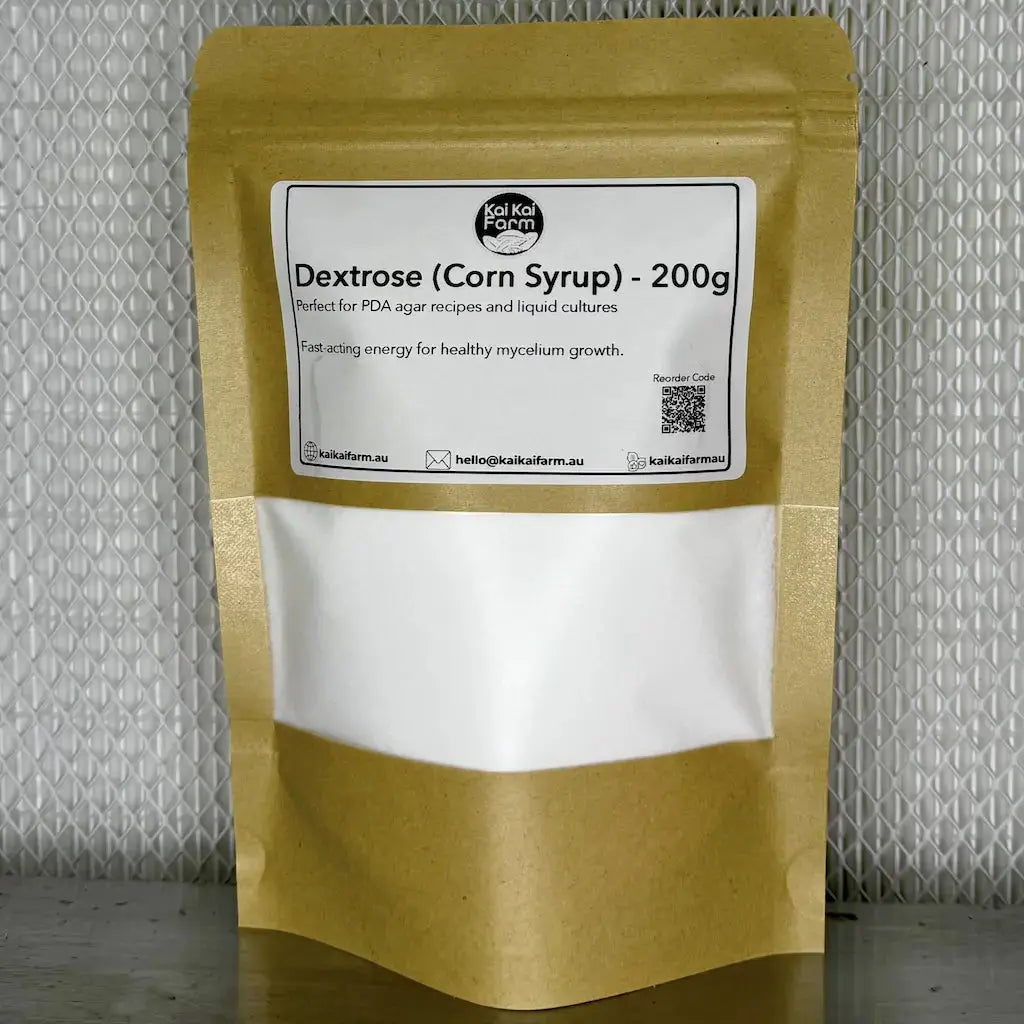
  • A fine white powder that dissolves quickly and completely in warm water with no residue or cloudiness

Why glucose is the universally preferred carbon source for fungi: Glucose (dextrose) is the direct substrate for glycolysis — the metabolic pathway that every living cell, including fungal mycelium, uses as its primary energy-generating process. Every other sugar type (sucrose, maltose, starch) must first be converted to glucose before it can enter this pathway. By providing glucose directly, you remove an entire metabolic step, freeing up enzymatic resources for growth rather than digestion. Academic studies on fungal growth media consistently show glucose producing the highest initial growth rates across species — it is, in a literal sense, the most bioavailable carbon source that exists.

The clarity trade-off — and how to address it: The limitation of a pure dextrose medium is nutritional simplicity. Glucose provides energy but no nitrogen, B-vitamins or trace minerals — the compounds that malt extract contributes naturally. For agar work where nutrition matters, the PDA recipe (potato + dextrose + agar) addresses this by using potato starch and minerals as a nutritional complement to glucose. For liquid culture, adding 2–5g of nutritional yeast powder per litre provides the nitrogen component while preserving the clarity that makes dextrose LC so useful for contamination monitoring.


Recipes

Two core applications — autoclave at 15 PSI / 121°C for 20 minutes for both.

🧫

PDA — Potato Dextrose Agar

The classic all-purpose agar used in mycology labs worldwide

Per 500 mL

500 mL water

4g plain potato flakes

10g dextrose

10g agar agar powder

Per 1 litre

1L water

8g plain potato flakes

20g dextrose

20g agar agar powder

Method: Add potato flakes to water and stir until dissolved — no boiling required with dehydrated flakes. Add dextrose and agar, stir briefly to distribute. Autoclave at 15 PSI / 121°C for 20 minutes. Pour at ~50°C into 90mm petri dishes at 20–25mL per plate.

⚠️ Potato flakes: Use plain, unflavoured instant potato flakes with no added salt, butter or seasoning. Check the ingredients label — it should list only dehydrated potato. Salt and flavour additives will inhibit culture growth.
🧪

Simple Dextrose Liquid Culture

Clean, clear and fast — the go-to LC for contamination-conscious growers

Per 500 mL

500 mL distilled water

10–15g dextrose

Per 1 litre

1L distilled water

20–30g dextrose

Method: Combine dextrose and water, stir to mix. Autoclave at 15 PSI / 121°C for 20–30 minutes. Allow to cool to room temperature before inoculating. The finished LC will be water-clear — any cloudiness, colour or sediment after inoculation indicates contamination.

Use 10–15g per 500mL for a lighter LC (slower growth, cleaner observation). Use 15g per 500mL for denser, faster mycelial mass. For added nitrogen without losing clarity, add 1–2g of nutritional yeast powder per 500mL — this produces a very slightly hazy LC that is still far clearer than malt-based alternatives.

🔍 Reading your clear LC jar — what to look for

✅ Healthy

Water-clear liquid with white, rope-like or fluffy mycelial mass. No odour or off-colour. Mycelium moves as a single mass when swirled.

⚠️ Contaminated

Cloudy or murky liquid · colour change (green, pink, orange, brown) · film on the surface · sediment that isn’t mycelial · off or sour odour on opening. Discard and do not inoculate from.


How far does a bag go?
Bag size PDA agar (20g per litre) Dextrose LC (20g per litre)
100g 5 litres · ~200 plates
or 10 × 500mL batches
5 litres
10 × 500mL LC jars
200g 10 litres · ~400 plates
or 20 × 500mL batches
10 litres
20 × 500mL LC jars

PDA plate yield at 25mL per 90mm dish, 40 plates per litre. LC based on 20g dextrose per litre (10g per 500mL jar). At the 15g per 500mL concentration the yield reduces proportionally.

Storage
Cool, dry location — sealed between uses. Dextrose is hygroscopic and will absorb ambient moisture, causing it to clump or cake. Reseal the bag tightly after every use and store away from humidity, steam and temperature fluctuation. A pantry or dry cupboard is ideal. Stored correctly, dextrose has an indefinite shelf life — it does not degrade or lose effectiveness over time. If it has clumped, break it up before measuring; it dissolves normally regardless.

Complete your PDA and LC setup

🧫 Agar Agar Powder →

The gelling agent for PDA. Lab-grade, 1,000 g/cm² gel strength. Used at equal parts with dextrose in the PDA recipe — a 100g dextrose bag pairs directly with a 100g agar bag.

🌱 Nutritional Yeast →

Adds nitrogen and B-vitamins to dextrose-based media without compromising clarity. 1–2g per 500mL is enough to meaningfully boost mycelial density while keeping your LC visually readable.

Choosing your size
Size Best for
100g Getting started with PDA and dextrose LC · 10 × 500mL LC jars or ~200 PDA plates · a very affordable entry point to try the recipes before committing to larger quantities
200g Regular agar and LC workflow · multiple species in rotation · best value per gram · enough for a full season of PDA and LC work without reordering

Benefits

Quick Energy: Provides a direct sugar source that helps mycelium colonize your media faster.

Easy Digestion: Some mushroom species prefer the simple structure of Dextrose over heavier grain-based malts.

Dissolves Instantly: The fine powder stirs into warm water easily, making your prep work fast and clump-free.

100% Pure: No fillers or additives—just pure fuel for your fungal cultures.

How do I use it?

1. Classic PDA (Potato Dextrose Agar)
500ml Water (from boiled potatoes for extra nutrients)

10g Dextrose

10g Agar Agar Powder

The go-to recipe for strong, healthy growth.

2. Simple Liquid Culture
500ml Distilled Water

10g to 15g Dextrose

A clean, simple mix for expanding your mycelium in jars.

Available Sizes

100g – Great for hobbyists & small batches
200g – Ideal for regular growers

Delivery Information

  • We ship from Tamborine Mountain, QLD using either AusPost or Aramex
  • Fast dispatch within 1-2 business day (excluding Fridays) with express post options available

Why Customers Love Us

  • Australian Owned
  • Family Business
  • Sustainability
View full details